
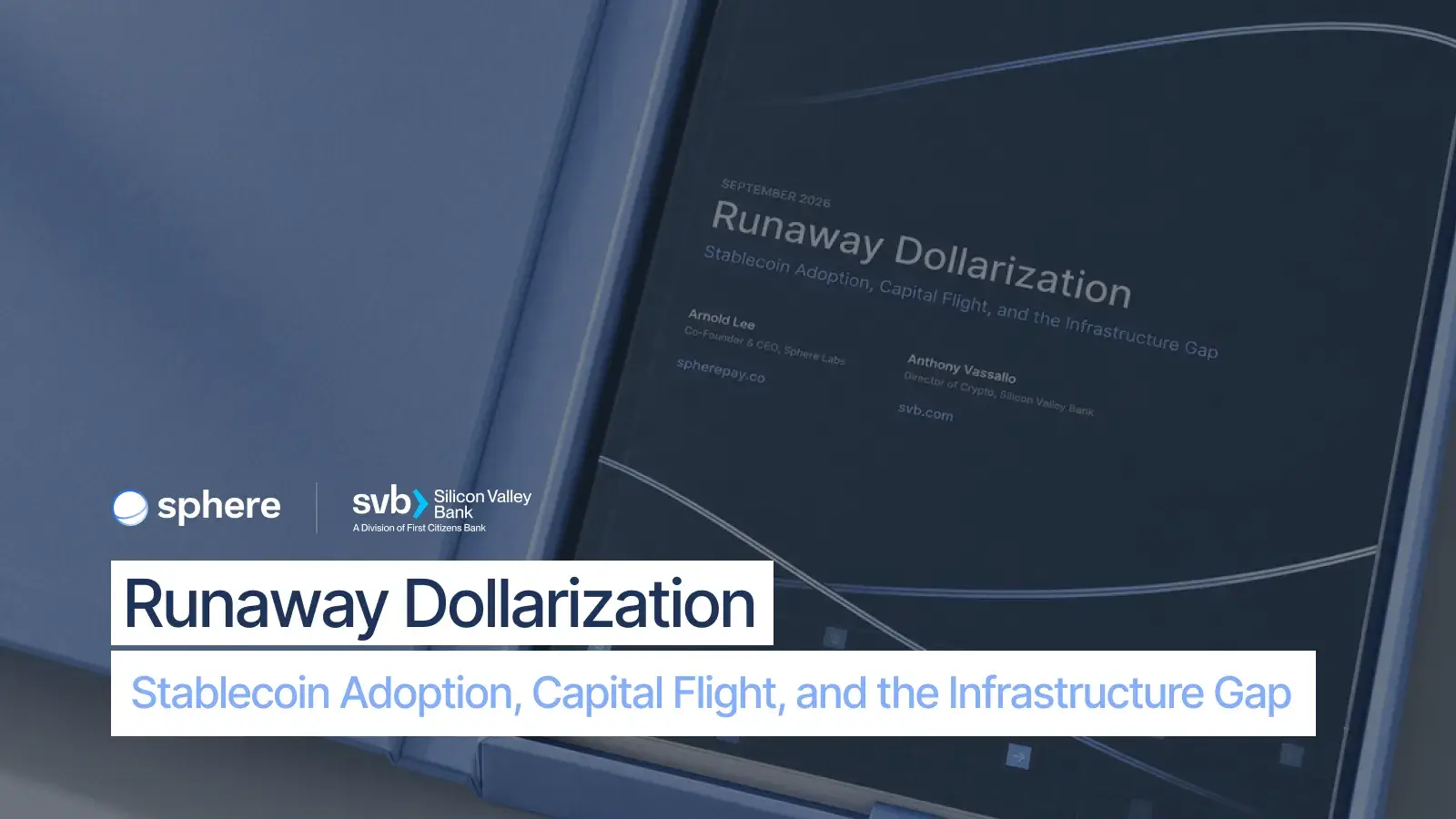
Runaway Dollarization: Stablecoin Adoption, Capital Flight, and the Infrastructure Gap
A co-authored report with Silicon Valley Bank on USD-denominated stablecoin adoption, and considerations for oversight a responsible transition depends on.
Get the full report PDF in your inbox
Executive Summary
- Stablecoins are becoming the internet's dollar. More than $300 billion circulates and throughput now rivals major payment rails. But stablecoins are also about sovereignty.
- When citizens in high-inflation economies move from local currency into digital dollars, monetary transmission weakens, deposit bases erode, and pressure builds faster than central banks can respond. The next phase will be decided by infrastructure, enforceability, and visibility.
- Two clocks matter. One is slow: currency substitution, deposit erosion, and weakening policy transmission building over months or years. One is fast: a depeg, issuer shock, or banking event that can move capital at software speed within hours.
- Demand is rational. People fleeing a weak currency are not looking for a more efficient version of it; they are exiting the system. Meeting that reality requires supervisory visibility through regulated stablecoin infrastructure, not around it.
- Post-fact compliance is not control. Existing frameworks were built for correspondent banking. They create accountability after the fact. They do not create control at software speed.
- Architecture is policy. How stablecoin infrastructure is designed determines who can enforce rules, when, and across which jurisdictions. Those decisions are being made now.
- The window is narrowing. Each quarter of adoption that locks in the current architecture makes the next intervention more costly. Institutions with the authority and relationships to shape this infrastructure have a shrinking window to use them.
Introduction
Dollar-denominated stablecoins have become a widely accessible form of monetary stability for hundreds of millions of people. The governance frameworks required to support that infrastructure at scale are still being assembled, largely through ad hoc public-private coordination, in a market that has moved faster than any single framework was built to anticipate.
In markets representing over a billion people, stablecoin holders have arrived at the same conclusion: dollar-denominated digital assets hold their value in ways local currency has not. Many of these markets are G20 members, major commodity exporters, and key nodes in global trade. For users in those markets, nobody calls them stablecoins. They call them dollars. Dollars that settle on open, permissionless networks.
The risk is systemic dollar substitution, playing out on two distinct timescales.
Channel 1: Structural Erosion
Operates over years. As adoption deepens, emerging market (EM) deposit bases hollow out, interest rate transmission weakens, and the conditions for a local currency confidence crisis accumulate quietly.
Channel 2: Acute Contagion
Operates in hours. A depeg event, an issuer failure, or financial sector stress transmits into currency pressure faster than any central bank intervention framework can respond.
Available evidence suggests that both channels are already active and growing increasingly visible. They will likely require different regulatory responses, and current tools were purpose-built for neither. This is understandable: these instruments do not map cleanly onto existing regulatory categories, and adoption crossed the systemic threshold faster than any regulatory cycle could fully complete.
Existing supervisory frameworks were built for capital that moves through supervised intermediaries, slowly enough to intercept, visible enough to track. Stablecoins settle in seconds, cross borders without intermediaries, and move peer-to-peer outside the supervised entry and exit points that existing compliance frameworks were built around. While those frameworks still supervise the on- and off-ramps to cash, the practical utility of this moment for financial inclusion will likely depend on complementary infrastructure that current frameworks were not designed to support.
What follows is a set of observations on what a compliance-native infrastructure layer for tokenized fiat-denominated instruments like stablecoins will need to address. Most of the current debate understandably centers on issuer regulation. That matters. But issuer-level controls are limited to minting and redemption. The harder problem is what happens after: how tokens move, settle, and interact with banking systems across jurisdictions, at a speed existing supervisory tools were never built to match. While this article focuses on the emerging market dollarization dynamic, the infrastructure requirements apply with equal force to developed market enterprise settlement and cross-border payments, a transformation worth examining on its own terms.
This paper is written for operators with an opportunity to shape what comes next for the future of money. Restricting access to goods with persistent demand and low barriers to supply has a consistent historical record: activity migrates into informal markets that are harder to supervise, harder to tax, and harder to reintegrate into the formal economy. Dollar demand in these markets is structural, driven by rational actors seeking monetary stability. The practical effect of prohibition in this context is reduced visibility into flows that regulators need to see most. The evidence points toward better infrastructure, better ramps, and better visibility, developed proactively rather than assembled under the pressure of a market stress event.
1. Scale Changes Everything
The global stablecoin market grew from $205 billion to approximately $307 billion during 2025, nearly 50% in twelve months¹, while U.S. M2 money supply grew 4% over the same period². Stablecoin market capitalization is now comparable to the monetary base of mid-sized sovereign economies. That figure still understates the momentum.
That growth has been led by issuers who have done something significant: build globally accessible monetary infrastructure that serves enterprise treasury and cross-border settlement in developed markets while simultaneously reaching populations that have traditionally had less access to financial solutions. Tether alone reports more than 650 million users worldwide⁵, the majority in emerging economies. Circle, Paxos, Agora, and other regulated issuers have collectively built infrastructure that, in many markets, represents one of the most accessible forms of stable financial access available today.
The scale this has produced could outrun any individual issuer's design or control. The largest stablecoin issuers now hold combined treasury exposure that exceeds the sovereign treasury positions of most of the world's nation-states, a position assembled through open-market activity in roughly a decade. Reserve verification for those holdings still occurs through periodic attestation, not a full audit. In practice, an attestation confirms a snapshot; it does not provide continuous visibility into reserve composition, counterparty exposure, or real-time accuracy between reporting periods. The gap between stablecoin scale and stablecoin transparency is a tragedy of the commons, a structural feature of infrastructure the market has outgrown. As evidence, the largest stablecoin issuer, Tether, completed its first full independent audit in August 2026, conducted by KPMG⁵ — a step toward closing that gap, and a signal that the market recognizes it exists.
The Bank for International Settlements (BIS) has documented the relationship between stablecoin flows and sovereign debt markets⁶. BIS analysis finds that a $3.5 billion five-day inflow into major stablecoins lowers 3-month Treasury bill yields by 0.71 basis points on impact, rising to 4 basis points within 10 days. Effects are state-dependent, increasing under Treasury market stress and with the scale of the stablecoin sector. In 2025 alone, dollar-backed stablecoins purchased roughly $35 billion of U.S. Treasury bills, on par with the largest investors in that market. As a testament to the promise and accomplishments of this technology, the issuers of an asset class that did not exist 15 years ago are now material participants in U.S. sovereign debt markets.
2. Where Adoption Is Concentrating and Why It Matters
Stablecoin adoption is concentrated in markets that have not been historically prioritized in finance. In Chainalysis's 2025 Global Crypto Adoption Index, which weights for factors like population and purchasing power parity to capture grassroots adoption rather than raw volume, India leads globally, with Pakistan, Vietnam, and Nigeria all ranking in the top ten. The U.S. ranks second⁷. On stablecoin usage as a share of domestic financial activity and active currency substitution behavior, the concentration is disproportionate in economies experiencing persistent inflation and weak currency performance. Turkey's stablecoin purchases reached 4.3% of GDP in 2024, compared to 0.5% in the United States and 0.4% in the EU⁸. The International Monetary Fund (IMF) estimates show the same pattern at the regional level: stablecoin flows in Latin America and the Caribbean reached 7.7% of GDP and in Africa and the Middle East 6.7%⁹.
A note on behavior: users in these markets are using stablecoins as working capital and a store of daily stability. The functional equivalent of a checking account in a currency that holds its value. The store-of-value question comes later, once savings accumulate. Dollar stability comes first.
These are early indicators of a pattern that Standard Chartered projects will expand dramatically: stablecoin holdings in emerging markets could grow from approximately $173 billion in 2025 to $1.2 trillion by 2028. This implies that, if those projections materialize, more than $1 trillion could flow out of emerging market banks over the next three years.
Research on financial dollarization suggests that sustained currency substitution erodes the incentive structures that maintain confidence in local currency in ways that are difficult to reverse¹⁵. Measuring stablecoin adoption against this threshold precisely is beyond current capability: stablecoin wallets are invisible to central bank deposit statistics, and the standardized reporting framework that would allow regulators to calculate the ratio in real time remains unbuilt. The countries most at risk may cross the threshold without any supervisory warning. What the available evidence indicates, via on-chain transaction volumes relative to GDP, informal FX market dynamics, and foreign reserve pressure, is that some nations are already operating in ranges where the threshold is a near-term risk. There is risk within markets collectively representing over three billion people and more than $10 trillion in GDP.
Currency substitution in emerging markets has a long and well-documented history. What distinguishes this episode is unprecedented velocity. When this has previously happened, those most at risk were individuals, workers, small business owners. What preceded these episodes was, in part, a measurement gap. The instruments available to authorities were designed for a different operating environment, and the dollarization threshold was crossed without adequate supervisory warning.
Stablecoins themselves do not create sovereign debt crises. But they accelerate the currency substitution dynamics that precede them, compress the timeline in which those dynamics become irreversible, and do so through channels that existing measurement infrastructure cannot observe in real time. The threshold has now dropped to the cost of a smartphone and a mobile data connection.
Citizens seeking refuge from inflation are looking for monetary stability in alternative denominations. The same applies to local currency-denominated stablecoins: digitizing a depreciating currency does not create demand for it. A credible central bank digital currency (CBDC) requires appropriate governance conditions, technical infrastructure, independent monetary authority, and rule of law around digital property rights. In many of the markets where stablecoin adoption is highest, those conditions remain under development.
Without a viable CBDC path in these markets, supervisory visibility over digital dollar flows and payments now depends on regulated stablecoin infrastructure. Whether those frameworks arrive by design or by crisis is the open question.
The cost of inaction is already visible. In Nigeria, Pakistan, and Egypt, the Financial Stability Board (FSB) Correspondent Banking Data Report documents a sustained pattern of de-risking that has reduced access to formal cross-border banking services, pushing activity toward informal channels where costs are significantly higher, settlement takes longer, and regulatory protection is limited¹⁶.
The developed market counterpart is equally striking: stablecoin growth could generate up to $1.4 trillion in additional dollar demand by 2027, reinforcing the dollar's role in global finance¹⁷. SVB reached a parallel conclusion in its 2026 outlook on crypto, describing stablecoins as poised to become the internet's dollar as on-chain dollars graduate from pilot programs into enterprise treasury workflows, cross-border settlement systems, and programmable B2B payments at institutional scale¹⁸. Both things can be true simultaneously. What strengthens dollar dominance at the macro level can destabilize individual currency regimes at the sovereign level. The tension between those two outcomes is where regulators around the world need to focus.
3. The Speed Gap
At the center of this challenge is a structural mismatch. Capital now moves at software speed, but the infrastructure gap remains.
On-chain transactions settle with finality in seconds, crossing jurisdictional lines without the intermediaries that traditional enforcement frameworks depend on. Capital that once required days of wire processing and settlement confirmation can now exit a financial system before a regulator's morning briefing concludes. Traditional enforcement operates through a chain of supervised institutions, each with controls at the point of issuance, intermediation, settlement, and custody. Investigations require process. Asset freezes require legal authority. Cross-border coordination is measured in weeks at best, given jurisdictional fragmentation and the absence of real-time information sharing between supervisory authorities.
Capital has always moved faster than enforcement in moments of stress. Stablecoins widen that gap by orders of magnitude, compressing days and weeks into seconds and minutes. The same speed that makes stablecoins transformative for cross-border commerce, payroll settlement, and remittances, unlocking financial access for populations and businesses that traditional rails have struggled to reach, also makes them uniquely difficult to govern in moments of systemic stress: currency runs, capital flight, and contagion events.
A small business owner in an unstable market needs only a wallet, an internet connection, and the judgment that dollars, even in digital "stablecoin" form, present a stable alternative to local currency. When millions of people make that judgment simultaneously, with settlement in seconds, the outflow velocity exceeds anything traditional capital controls were built to manage. The solution is architectural, operating on a dimension that current regulation was not built to address: time.
The enforcement tools that exist today were designed for a different environment. Analytics platforms reconstruct transaction pathways after the fact, with attribution often refined months or years after initial analysis. Issuer-level compliance frameworks operate at the moment of minting and become ineffective once tokens enter secondary circulation on permissionless networks where transaction validation is open to any participant. Issuers can and do freeze wallets: Tether's freeze authority operates through a blacklist function in the USDT smart contract; it can freeze any wallet address, custodial or self-hosted, without intermediary access. It has done so for more than $4.4 billion in assets across more than 2,300 cases globally, including over $2.1 billion tied to U.S. authorities¹⁹, but those freezes follow formal law enforcement requests that can be lengthy. The speed at which capital moves exceeds what any of these tools were designed to match.
This dynamic is specific to stablecoins. Volatile tokens such as SOL and ETH are ill-suited to function as payment instruments due to price instability. Users seeking to preserve or transfer value via blockchain infrastructure are more likely to do so in dollar-denominated stablecoins such as USDC than in native tokens. The compliance gap exists because stablecoins combine the settlement speed of blockchain infrastructure with the price stability of a fiat-denominated instrument.
The question that remains open is what a comparable event looks like when it originates not in a speculative crypto ecosystem but in an emerging market banking system, at a scale where no issuer reserve fund is large enough to restore confidence, no central bank has the dollar liquidity to intervene, and no FDIC-equivalent backstop exists to anchor a recovery.
The closest precedent, the 2022 collapse of the TerraUSD (UST) stablecoin²⁰, was largely contained because deep dollar liquidity was available in the broader U.S. financial system. For most of the world, that condition does not hold.
4. The Limits of Current Approaches
Existing regulatory tools have advanced the baseline, but their structural limits are worth examining.
The most advanced frameworks currently in development, including the GENIUS Act in the United States and Markets in Crypto-Assets (MiCA) in the European Union, are primarily issuer-level instruments. They establish meaningful standards: 1:1 reserve requirements, redemption rights, and AML compliance programs create a more accountable issuance environment²¹. Yet issuer-level controls end at the point of minting. Once a token enters secondary circulation, transferred from wallet-to-wallet across jurisdictions, the issuer's compliance posture has limited reach. The natural regulatory response is to require issuers to freeze non-compliant wallets on demand, and most regulated issuers can do exactly that for wallets they can identify. The structural limit appears once tokens enter secondary circulation. A peer-to-peer transfer across unhosted wallets carries limited originator or beneficiary data, leaving the issuer with little visibility into who is moving what, where.
In a capital flight scenario, the wallets moving the most volume are disproportionately likely to be the ones where issuers have limited visibility. A single peer-to-peer transfer can move tokens outside every compliance checkpoint the issuer controls. Even at the infrastructure layer, compliance tooling that exists today operates on an opt-in basis, meaning no participant is required to use it. In the structural erosion channel, this means deposit-level currency substitution can accumulate largely outside issuer visibility. In the acute contagion channel, the run can be completed before the issuer has received a single freeze request. The primary compliance touchpoint, where one exists, occurs at off-ramp or redemption. By that point, the capital movement has already been completed.
The most broadly deployed complementary tool, blockchain analytics, usually works backward. For example, Chainalysis's annual illicit crypto volume figures are routinely revised upward in subsequent reports as on-chain attribution improves, a reflection of the months required to map wallet addresses to known entities, rather than a flaw in methodology²². In the context of capital flight, where the relevant timeline is measured in hours, post-hoc reconstruction arrives too late. The underlying architecture contributes to this lag. Permissionless blockchain design introduced a tradeoff: the same openness that enabled rapid global adoption also means rules applied after settlement provide accountability without real-time control. That works for record-keeping. It becomes a constraint when the problem requires intervention before the transaction is complete.
Efforts to make these tools more real-time have progressed, with screening APIs and monitoring platforms now capable of flagging suspicious activity within minutes at supervised endpoints. Even at the block construction layer, where transactions are ordered and assembled before settlement, emerging infrastructure has demonstrated that pre-settlement filtering is technically feasible.
The constraints are twofold: participation in these systems is voluntary and socially enforced rather than protocol-enforced, and neither the technical infrastructure nor the supervisory frameworks required to make compliance a mandatory condition of transaction inclusion are production-ready. No regulator has yet defined what compliant block construction looks like, who would supervise it, or how liability would attach. The closest effort, a joint FinCEN and OFAC proposed rule published in April 2026, remains pending after its public comment period closed in June 2026, and explicitly sought industry input on these questions²³. The result is a compliance architecture that reaches the endpoints it can see and misses everything in between — governing honest participants to compliance and likely not the actors it was designed to catch.
Current approaches describe a compliance posture that is reactive by design. In a world where capital can exit a jurisdiction in minutes and settlement is irreversible by default, reactive compliance can be a structural disadvantage, a reflection of tools built for a different operating environment, one where capital moved through supervised intermediaries. They document what happened. Against the speed gap, documentation ceases to function as a control against systemic risk.
5. Requirements of Purpose-Built Infrastructure
Digital dollar infrastructure is already improving financial access for hundreds of millions of people. The goal is to ensure that transition is appropriately governed so that the same infrastructure driving financial inclusion remains stable and trustworthy at scale. The credibility this industry has earned over the past decade is best protected by the industry helping to shape the governance framework through sober analysis, rather than waiting for them to arrive in response to a crisis. The dynamics described in Sections 2 through 4 suggest that closing the speed gap will require moving compliance from the application layer to the network layer, embedding end-to-end visibility in how transactions are validated and settled, at the protocol level, before finality. Whether that conclusion is correct is worth debating. What the evidence makes difficult to argue is that today's application-layer compliance alone is sufficient at the scale these instruments now operate.
There is a compelling economic case for this architecture. The global cost of financial crime compliance across financial institutions now exceeds $206 billion annually²⁴. When identity, licensing status, and regulatory standing can be cryptographically attested at the infrastructure layer, those attestations become reusable assets. Multi-decade progress in zero-knowledge (ZK) proofs and modern cryptography now makes this operationally feasible. Compliance becomes additive rather than duplicative. The economics shift: compliant infrastructure transitions from cost center to throughput accelerator, reducing friction for legitimate participants while strengthening the controls that regulators require.
The economic case alone would justify investment. The systemic-risk case reinforces it: current tools remain necessary, but they operate on timelines and at layers that cannot match the speed at which tokenized dollars now move. The four capabilities set out in this section describe the infrastructure best positioned to support these instruments at scale in regulated contexts. This paper endorses no specific provider or technology stack. Instead, it identifies the functional capabilities that compliant infrastructure is likely to require and the criteria against which any candidate approach can be assessed.
The first is pre-settlement policy enforcement. Compliance in digital asset markets has historically been applied at the application layer: screening APIs at exchanges, monitoring dashboards at custodians, flagging tools at on-ramps. These controls have served the industry well and remain functional, though they operate above the settlement layer. This means a compliant application can reject a transaction, but the underlying network may still process it if submitted through a different path, often by pseudonymous participants with no obligation to use compliant tooling. Infrastructure designed for regulated use at scale would benefit from the ability to enforce jurisdictional eligibility, counterparty permissions, and exposure limits at the settlement layer itself, with violations addressable before finality, complementing the audit-and-log mechanisms that operate after settlement.
The second is jurisdiction-native compliance. A transaction permissible between two parties in one regulatory environment may be prohibited in another. A remittance from the United States to Nigeria requires simultaneous compliance with FinCEN reporting and OFAC screening, then with Central Bank of Nigeria (CBN) foreign exchange rules on arrival. A corporate treasury settlement between Singapore and the EU triggers Monetary Authority of Singapore (MAS) and MiCA requirements that differ in scope, threshold, and reporting cadence. Retail users and institutional counterparties operate under materially different requirements within the same jurisdiction. Infrastructure intended for global regulated use would benefit from encoding these distinctions natively, with different rule sets applicable to different participant classes and jurisdictional contexts, distributed across the full transaction lifecycle rather than concentrated at the on-ramp and off-ramp. Without such capability, each regulated institution maintains its own compliance stack for every corridor it operates in, a cost structure that constrains participation and slows adoption.
The third is confidentiality with auditability. Institutional finance requires that counterparties transact without exposing commercially sensitive information to public observation. Regulators require verifiable compliance without bulk data access that creates its own security considerations. Cryptographic approaches now exist that can enable a party to demonstrate compliance with a specific rule (sanctions screening, exposure limits, licensing status) without revealing the underlying transaction data. Zero-knowledge proofs, a cryptographic method by which one party can demonstrate the truth of a statement to another without disclosing the underlying information, are one such approach; others may emerge as the technology matures. Centralized routing of compliance attestations carries its own operational considerations, including single points of failure and concentrated data exposure that have been observed across both traditional and digital financial infrastructure. Cryptographic attestation of compliance offers a path to institutional adoption and regulatory accountability that addresses these considerations directly.
The fourth is interoperability with central bank systems. Different jurisdictions will reach different conclusions about the role of central bank digital currencies in their settlement infrastructure, based on institutional capacity, governance traditions, monetary policy priorities, and practical timelines. These are sovereign decisions shaped by local conditions, and this paper takes no position on which path any jurisdiction should choose. Globally harmonized standards for interoperability and compliance reporting, however, would support coordination across what is inherently cross-border activity, regardless of which domestic settlement path any jurisdiction pursues. What matters for the infrastructure layer is adaptability: the ability to operate in parallel with traditional fiat issuance, rails, and dissemination, to integrate with CBDCs where they exist, with regulated bank rails where they are more practical, and with hybrid models as they emerge. For regulated financial institutions and systemically important participants, infrastructure that can operate across this full spectrum supports broad adoption while preserving global financial coordination.
These four capabilities define a settlement layer where compliance is a property of the network itself, enforced before finality, invisible to legitimate participants, and structurally unavoidable for everyone else. Purpose-built infrastructure embeds accountability into how transactions are submitted. Retrofitted compliance appends it after the fact. Against the speed gap described in this paper, only one of those closes the loop.
Infrastructure choices are policy choices. At what scale and for which participants should compliance be a structural property of the settlement layer? That question sits at the center of a live and contested architecture debate, and this paper takes no position on its resolution. What it does observe is that when flows could accelerate the sovereign-level dynamics described in this paper, or when systemically important institutions are transacting on these rails, compliance before settlement becomes a functional requirement. How that is implemented will vary by jurisdiction, use case, and regulatory maturity, and the path forward will be shaped by sustained collaboration among infrastructure providers, regulated institutions, and supervisory authorities. That design conversation is only beginning.
Any move toward pre-settlement compliance must come with governance constraints. A system that can prevent settlement is powerful enough to require due process, appeal rights, emergency-use limits, transparency reporting, auditability, and clear rules on who can trigger intervention. Privacy-preserving compliance attestations should be preferred where they satisfy supervisory requirements without exposing commercially sensitive or personally identifying data. The objective is a governed settlement environment in which regulated participants meet legal obligations without recreating the opacity, duplication, and crisis-time improvisation that current systems already struggle to manage, while maintaining robust verification.
Every prior attempt at shared compliance infrastructure, whether focused on KYC utilities, transaction monitoring consortia, or interbank data-sharing frameworks, has stalled at the same point: coordination costs are front-loaded, savings are back-loaded, and participation was voluntary. Several centralized approaches that achieved adoption subsequently demonstrated concentration risks: single points of failure, data breaches, and operational fragility. Others repackaged existing governance structures with new technology without rethinking the underlying economics of participation and control. What is structurally different in 2026 is a regulatory demand signal. The GENIUS Act and MiCA create compliance requirements that make investment in this infrastructure commercially necessary rather than aspirational. When participation shifts from voluntary to required, the coordination problem becomes tractable for the first time.
6. The Moment for Constructive Engagement
More than a dozen major jurisdictions, including the United States, the European Union, the United Arab Emirates, Japan, Singapore, Hong Kong, Brazil, South Korea, and others, are at various stages of developing stablecoin regulatory frameworks. Progress is uneven. Only 5 FSB-assessed jurisdictions had finalized stablecoin-specific frameworks as of August 2025²⁵. The gap between developing a framework and having one is precisely where the speed gap lives, and where regulatory arbitrage emerges within months of its creation.
Regulatory frameworks set rules. Infrastructure requires different decisions entirely. A well-designed regulatory framework applied to poorly designed infrastructure still produces poorly designed outcomes. The speed gap closes when systems enforce those rules at the speed at which the underlying assets move.
Several developments in the past year have made 2026 the critical window. The GENIUS Act, signed into law in July of 2025, set OCC and FDIC rulemaking deadlines of July 2026, which regulators did not meet, and will take full effect no later than January 2027²¹. The infrastructure decisions being made now will need to interface with those requirements within the year. MiCA entered full enforcement across EU member states, creating bank-comparable compliance obligations for stablecoin issuers in the world's largest single market. Institutional adoption has crossed a threshold from pilot programs into enterprise plumbing: treasury workflows, cross-border settlement systems, and programmable B2B payment infrastructure, at a scale that makes the underlying architecture increasingly hard to revise. Path dependencies are accumulating. Retrofitting becomes more expensive and more disruptive with each quarter that passes.
Three categories of decisions will shape the outcome.
On Cross-Border Coordination
The FSB and BIS already have the multilateral convening authority to treat cross-border stablecoin flows as a coordination problem, rather than a queue of sequential national decisions. The specific instrument needed is a cross-border supervisory data-sharing framework, equivalent in design to what the Basel Committee established for banking, that would allow central banks to monitor stablecoin-driven capital flows in real time across jurisdictions. At the current completion rate, regulatory gaps function as arbitrage corridors. National frameworks, however well-designed, leave a speed gap that operates across jurisdictions simultaneously. The Basel precedent demonstrates both that this kind of coordination is possible and that it takes years to implement. That timeline argues for starting now.
On Institutional Participation
OCC Interpretive Letter 1186 and the GENIUS Act framework together provide the clearest engagement authority in years²⁶. Tokenized deposits and stablecoins serve different perimeters in this framework. Institutional clients will use both. Financial institutions have an opportunity to shape the architecture of this market. Design decisions being made now will define compliance standards, interoperability requirements, and institutional access rules for years. Institutions that participate in this process early will have influence over those standards. The decisions compound: infrastructure architectures adopted today will shape the competitive landscape for a decade. For institutions with existing emerging market corridor exposure, the calculation has an additional dimension: a stablecoin-linked currency event transmits through correspondent relationships regardless of whether those institutions helped build the underlying infrastructure.
On Technical Standards
The four core functions outlined in Section 5, pre-settlement enforcement, jurisdiction-native compliance, confidentiality with auditability, and interoperability with central bank systems, warrant consideration as a baseline standard comparable in spirit to Basel capital requirements for traditional banking. The BIS Innovation Hub, SWIFT, and major regulated stablecoin issuers operating under MiCA and GENIUS Act compliance are well-positioned to help shape those standards. The cost of establishing them now is substantially lower than the cost of correcting infrastructure deficiencies after broad adoption.
Conclusion
Stablecoin adoption is being driven by a convergence of factors that appear structural in nature. The demonstrated utility of the underlying technology, the settlement velocity that permissionless networks enable, the volatility of local currencies that has driven substitution toward dollar-denominated alternatives in affected markets, and the self-reinforcing dynamic of adoption itself have together produced sustained demand that existing financial infrastructure has not fully addressed. That is the context in which these decisions are being made.
A stablecoin-linked currency stress event remains a possibility, and it would transmit at a speed the current intervention toolkit was never designed to match.
The stablecoin ecosystem has demonstrated what dollar-denominated infrastructure can offer to people and businesses that previously lacked access. Whether those systems ultimately protect users or expose them will depend on design choices currently being made, by institutions with meaningful reason to engage, and within a window that narrows as adoption continues to consolidate around the current architecture.
Disclaimers
The views expressed in this report are solely those of the authors and do not necessarily reflect the views of SVB.
This material, including without limitation to the statistical information herein, is provided for informational purposes only. The material is based in part on information from third-party sources that we believe to be reliable but which has not been independently verified by us, and, as such, we do not represent the information is accurate or complete. The information should not be viewed as tax, accounting, investment, legal or other advice, nor is it to be relied on in making an investment or other decision. You should obtain relevant and specific professional advice before making any investment decision. Nothing relating to the material should be construed as a solicitation, offer or recommendation to acquire or dispose of any investment, or to engage in any other transaction.
All non-SVB named companies listed throughout this document, as represented with the various statistical, thoughts, analysis and insights shared in this document, are independent third parties and are not affiliated with Silicon Valley Bank, division of First-Citizens Bank & Trust Company. Any predictions are based on subjective assessments and assumptions. Accordingly, any predictions, projections or analysis should not be viewed as factual and should not be relied upon as an accurate prediction of future results.
The inclusion of any third-party company, product, service, technology, or research in this report should not be construed as an endorsement, recommendation, or approval by Silicon Valley Bank, division of First-Citizens Bank & Trust Company.
About the Authors
Silicon Valley Bank is a division of First-Citizens Bank & Trust Company, serving the innovation economy. Anthony Vassallo, Director of Crypto, has spent ten years at the bank, eight of them bridging traditional banking and digital assets. He works directly with venture-backed blockchain pioneers, focusing on sustainable innovation. Prior to his current role, Anthony was a Vice President of Product Management at SVB, focused on commercial lending. Anthony also has experience in underwriting and portfolio management.
Arnold Lee is the Co-founder and CEO of Sphere Labs. Sphere operates SpherePay, cross-border payments infrastructure for global businesses and fintechs, and SphereNet, a compliance-native settlement fabric for regulated finance. Backed by Jump Trading, Coinbase, Kraken, and Solana Ventures, Sphere processes significant volume annually in cross-border payments across real-economy trade corridors, including some described in this paper.
This paper is published for informational purposes only. It does not constitute investment advice, legal advice, or regulatory guidance. The views expressed are those of the authors and do not necessarily represent the views of Silicon Valley Bank, a division of First-Citizens Bank & Trust Company, or Sphere Labs. Forward-looking statements involve risks and uncertainties and should not be relied upon as predictions of actual outcomes.
Works Cited
- DeFiLlama. Stablecoin Market Dashboard (real-time). https://defillama.com/stablecoins
- Board of Governors of the Federal Reserve System. "M2 Money Stock (M2SL)." FRED, Federal Reserve Bank of St. Louis. https://fred.stlouisfed.org/series/M2SL
- Standard Chartered. Kendrick, G. & Jna, M., Stablecoins – Implications for EM (Standard Chartered Global Research, October 6, 2025). https://www.sc.com/en/uploads/sites/66/content/docs/SC-CIB-Stablecoins-and-EM.pdf
- Citigroup. Stablecoins 2030, Citi Global Perspectives & Solutions (September 2025). https://www.citigroup.com/rcs/citigpa/storage/public/GPS_Report_Stablecoins_2030.pdf
- Tether. Tether Completes the Largest Inaugural Financial Audit in History (August 2026). https://tether.io/news/tether-completes-the-largest-inaugural-financial-audit-in-history/
- Bank for International Settlements. Ahmed & Aldasoro, Stablecoins and safe asset prices, BIS Working Papers No. 1270 (May 2025, revised February 2026). https://www.bis.org/publ/work1270.pdf
- Chainalysis. 2025 Global Crypto Adoption Index. https://www.chainalysis.com/blog/2025-global-crypto-adoption-index/
- Chainalysis. The 2024 Crypto Spring Report (April 2024). https://go.chainalysis.com/rs/503-FAP-074/images/The%20Crypto%20Spring%20Report.pdf
- Reuter, M. "Decrypting Crypto: How to Estimate International Stablecoin Flows." IMF Working Paper WP/25/141 (July 2025). https://www.imf.org/en/publications/wp/issues/2025/07/11/decrypting-crypto-how-to-estimate-international-stablecoin-flows-568260
- Flores, A. & Holloway, R. "How Argentina uses stablecoins, in 5 charts." a16z crypto (August 30, 2026), citing Artemis data. https://a16zcrypto.com/posts/article/how-argentina-uses-crypto-5-charts/
- Banco Central de la República Argentina. Exchange rate statistics (peso official reference rate). https://www.bcra.gob.ar/en/exchange-rates/
- Boston Consulting Group. Global Payments Report 2025: The Future Is (Anything but) Stable (September 22, 2025). https://www.bcg.com/publications/2025/global-payments-transformation-amid-instability
- Central Bank of Nigeria. Exchange rate statistics (naira official rate). https://www.cbn.gov.ng/rates/ExchRateByCurrency.html
- International Monetary Fund. "Stablecoins in Nigeria: A Growing Cross-Border Channel," Nigeria 2025 Article IV Consultation, Annex VII (June 2026). https://www.imf.org/en/news/articles/2026/06/16/stablecoins-in-nigeria
- Ize, A. & Levy Yeyati, E. Dollarization of Financial Intermediation: Causes and Policy Implications, IMF Working Paper WP/98/28 (March 1998). https://doi.org/10.5089/9781451844634.001
- Financial Stability Board. Correspondent Banking Data Report – Update (November 2018). https://www.fsb.org/uploads/P161118-2.pdf
- JPMorgan. Padh, Chandan & Popescu, Stablecoin adoption and dollar demand (October 7, 2025). https://www.jpmorgan.com/insights/global-research/currencies/stablecoins
- Silicon Valley Bank. Future of crypto: 5 crypto predictions for 2026 (December 23, 2025). https://www.svb.com/industry-insights/fintech/2026-crypto-outlook/
- Tether. Tether Supports Freeze of More Than $344 Million in USD₮ in Coordination with OFAC and U.S. Law Enforcement (April 23, 2026). https://tether.io/news/tether-supports-freeze-of-more-than-344-million-in-usdt-in-coordination-with-ofac-and-u-s-law-enforcement/
- CoinDesk. UST Stablecoin Falls Below Dollar Peg for Second Time in 48 Hours (May 9, 2022). https://www.coindesk.com/business/2022/05/09/ust-stablecoin-falls-below-dollar-peg-for-second-time-in-48-hours
- GENIUS Act (U.S., signed July 18, 2025), congress.gov/bill/119th-congress/senate-bill/1582; MiCA: Regulation (EU) 2023/1114; Payment Token Services Regulation (Central Bank of the UAE, June 2024)
- Chainalysis. 2025 Crypto Crime Report (January 2025). https://www.chainalysis.com/blog/2025-crypto-crime-report-introduction/
- U.S. Department of the Treasury. Permitted Payment Stablecoin Issuer AML/CFT Program and Sanctions Compliance Program Requirements. Federal Register, Doc. No. 2026-06963 (April 10, 2026). https://www.federalregister.gov/documents/2026/04/10/2026-06963/permitted-payment-stablecoin-issuer-anti-money-launderingcountering-the-financing-of-terrorism
- LexisNexis Risk Solutions. True Cost of Financial Crime Compliance. https://risk.lexisnexis.com/-/media/files/financial%20services/research/lnrs-tlp-true%20cost%20of%20financial%20crime%20compliance_2023.pdf
- Financial Stability Board. Thematic Peer Review on FSB Global Regulatory Framework for Crypto-Asset Activities (October 16, 2025). https://www.fsb.org/uploads/P161025-1.pdf
- OCC. Interpretive Letter No. 1186 (November 18, 2025). https://www.occ.gov/topics/charters-and-licensing/interpretations-and-actions/2025/int1186.pdf
About the author
.avif)
Arnold Lee
CEO & Co-founder, Sphere
Arnold Lee is the co-founder and CEO of Sphere Labs, which is building the infrastructure for faster, more transparent, and more accessible global money movement.
With a background in computer science and full-stack engineering, Arnold’s work spans firmware development for IoT sensors, distributed systems, and modern web applications. Before founding Sphere, he worked across hardware-adjacent software, cloud platforms, and data-driven systems, developing a strong foundation in building resilient, production-grade technology.
Arnold founded Sphere Labs in 2022 to address the inefficiencies in cross-border payments by combining stablecoin rails with regulated financial infrastructure. His focus is on designing systems that bridge traditional finance and blockchain technology, enabling compliant, real-world value transfer at global scale. He holds a BA in Computer Science from Columbia University.

Subscribe to Sphere Blog
No spam. Just the latest releases and tips, interesting articles, and exclusive interviews in your inbox every week.
Update to Individual Customer Verification: Source of Funds Now Required
Integrators have until October 19 to start collecting source of funds for individual verification.
Sphere Achieves SOC 2 Type II Certification
Independent validation of Sphere’s security, availability, and compliance controls through SOC 2 Type II certification.